
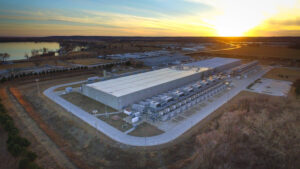
Google data center, Council Bluffs, IA
With control of Congress on the line in the midterms, a wave of bipartisan opposition to AI data centers has become one of the more unexpected developments of the campaign. Rising electricity bills tied to data center growth already helped Democrats flip a Georgia utility regulator’s seat last November, a preview of a fight now spreading into House and Senate races nationwide.
The anger fueling this fight is shared by voters in both parties, and it goes well beyond electricity bills. A poll found 77 percent of Americans are concerned data centers will raise their electric bills, with two-thirds of Democrats and half of Republicans saying they would oppose a data center in their own community. Independents are just as uneasy: a University of Massachusetts Amherst poll found 71 percent would oppose an AI data center in their own community, a higher share than the Republicans polled and close to the Democratic number.
Complaints about data centers also center on heavy water use, chronic noise from cooling systems that residents say disrupts sleep and raises health concerns. Scale is another flashpoint: a proposed 40,000-acre Utah campus, larger than Manhattan, drew enough community backlash that a Republican state Senate leader forced developers to significantly shrink it. A smaller group of lawmakers has raised even larger stakes, arguing that new construction should pause until Congress addresses what Rep. Alexandria Ocasio-Cortez calls “the existential harm AI poses to our society.”
With only a few exceptions, Democratic candidates, drawing on a traditional commitment to reining in corporate power, have turned that anger into a consistent argument. They have cast data centers as mega-corporations receiving outsized tax breaks while ordinary families absorb rising costs. Governors in several Democratic-led states have gone further, targeting the resource strain directly. New York’s Kathy Hochul signed the nation’s first statewide data-center moratorium, citing grid capacity, land use and water supply. Pennsylvania’s Josh Shapiro imposed new permitting rules requiring developers to cover their full electricity costs and limit water use.[8] California lawmakers have separately sent Gavin Newsom a package of bills addressing the industry’s electric rates and water consumption, awaiting his signature, just days after he signed the nation’s first law establishing independent safety auditors for AI systems.
Republicans are far less unified. Donald Trump and JD Vance are firmly in favor of continued data center growth, with Trump dismissing opponents as “backwards and poor.” Others, however, including Missouri Sen. Josh Hawley, have broken with that position and called for tighter limits on new projects. In one rare case, Oklahoma Republican state Senator Kendal Sacchieri introduced a bill calling for a three-year data center moratorium, saying her own party isn’t taking the issue seriously enough. But it feels like Republican politicians are playing “me too” or catch-up to the Democrats regarding data center opposition. And many Republican officials have avoided taking a position at all, with the NPR analysis cited above noting that the party has stayed quiet publicly because opinions inside it vary so widely.
Democrats have already been focusing on “affordability” as their major theme for the 2026 midterm elections. Opposition to data centers gives them another related issue on which to attack contrary Republicans and attract voters. Both issues have the advantage of plenty of grass-roots support across the political spectrum, thus creating an opportunity for the Democrats to draw votes outside of their base.
Photo by Chad Davis, used under Creative Commons license. https://tinyurl.com/34ecmyf4

