
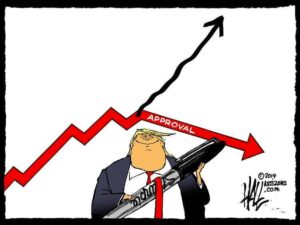
Trump’s wishes vs. reality
Donald Trump‘s political brand has rested on the promise that he can disrupt Washington bureaucracy and deliver results. His influence has also depended on his ability to keep Republican lawmakers aligned behind his priorities and convince voters that he can impose his agenda where other politicians fail.
That advantage depends on turning demands into outcomes. Recently, however, Trump has faced a series of incidents where that ability appears to be weakening.
The clearest examples have come from the courts. Recently, a federal judge halted Trump’s effort to create a federal voter list through executive action, ruling that the administration likely exceeded its authority. Another court blocked the administration’s attempt to use federal immigration data to verify voter eligibility. Federal appeals courts also rejected or dismissed Trump’s efforts to force Michigan and Pennsylvania, respectively, to hand over their voter rolls.
Congress has been another area of failure. Trump has repeatedly pushed Republicans to pass the SAVE Act, legislation that would require documentary proof of U.S. citizenship to register to vote in federal elections. The bill passed the House but has stalled in the Senate, where it has not attracted the votes needed to overcome a filibuster. Trump recently refused to sign a bipartisan housing bill unless Congress first passed the SAVE Act, turning a popular legislative measure into another case of extortion against Republicans. And at about the same time, Republican U.S. Senator Bill Cassidy engaged in a heated shouting match with Trump over the administration’s handling of the Iran war and its explanations to Congress, underscoring further tensions between Trump and the Republican conference.
The resistance against Donald Trump has also shown up in public opinion. Recent polling has placed Trump’s approval rating near the lowest levels of his presidency. Historical comparisons show that his ratings have remained unusually weak compared with many other modern presidents. Voters have also expressed doubts about Trump’s Iran war and continued concerns about the economy, inflation (lately referred to as “affordability”) and the Trump tariffs. Those issues strike directly at the political coalition Trump relied on by promising stronger leadership and better economic outcomes.
Democrats have already begun highlighting Trump’s legal setbacks, Republican resistance, and declining public support as evidence that his political position may be weakening before the 2026 midterm elections. Finally, as we have noted, Trump just turned 80, and there is plenty of evidence that both his physical and cognitive health are declining, including his frequent dozing in front of the cameras. The question is now whether Donald Trump can still impose his priorities, or whether Trump is becoming a lame duck well before his term is over.
Photo by FolsomNatural, used under Creative Commons license. https://shorturl.at/Hitbb

