

Home » Lincoln Project

Tag Archive: Lincoln Project

Will Democrats vote for former Republican George Conway for U.S. House?

George Conway

Coinciding with the five-year anniversary of the January 6 Republican U.S. Capitol insurrection, former Republican George Conway has announced his candidacy as a Democrat for the U.S. House in New York’s 12th Congressional District. Conway’s candidacy is sure to attract plenty of controversy, given his former high-profile status as a conservative lawyer helping the Republican Party, and husband of Kellyanne Conway during her term as advisor, campaign manager, and White House Counselor to Donald Trump before and during his first term (the Conways divorced in 2023).

New York’s 12th District is quite unusual and high-profile. Covering a chunk of Manhattan, it is simultaneously the smallest, one of the wealthiest, and one of the most Democratic of all U.S. Congressional districts. Obviously, it is also home to a number of news media headquarters and bureaus. The race this year in the district will be to replace retiring Democrat Jerrold Nadler, who was an outspoken member of his party. On the Democratic side, the contest has already attracted Jack Schlossberg, who is the telegenic grandson of President John F. Kennedy and daughter of Caroline Kennedy, as well as a slew of other candidates. Thus, the Democratic primary (which almost assuredly will yield the general election winner) promises to be a lively one.

2020, meet 1968

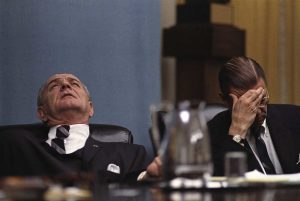
President Lyndon Johnson and Defense Secretary Robert McNamara, 1968

America torn apart by unrest. An overarching issue that has caused the deaths of many thousands of Americans. Separate protests and riots over the death of a black man. It’s a good description of 2020, right? Actually, this also describes the year 1968. There are some striking parallels between these two years, and they do not bode well for Donald Trump or the Republican Party.

In 1968, Lyndon Johnson, who had become president after John F. Kennedy‘s assassination in November 1963, faced the twin issues of the Vietnam War and racial unrest. The war so mired President Johnson and tore apart the country that, in March 1968, Johnson announced that he would not run for reelection. And then, just four days later, as if to ensure that America would remain in strife through the election, black civil rights leader Rev. Martin Luther King, Jr. was assassinated. Coming after years of bloody civil rights battles and documented police brutality, King’s murder led to protests and riots around the country. Johnson’s decision not to run for another term was already based in part in the reality that his approval rating throughout 1968 mostly hovered in the low forties range, having declined steadily from the highs of nearly 80 percent in his first few months after taking office, and was largely attributable to the Vietnam War.